Disc injury care in Lynnwood
A rubbery disc sits between each pair of spine bones. When its soft center pushes through the outer ring, it can press on a nerve and cause pain, numbness or weakness.
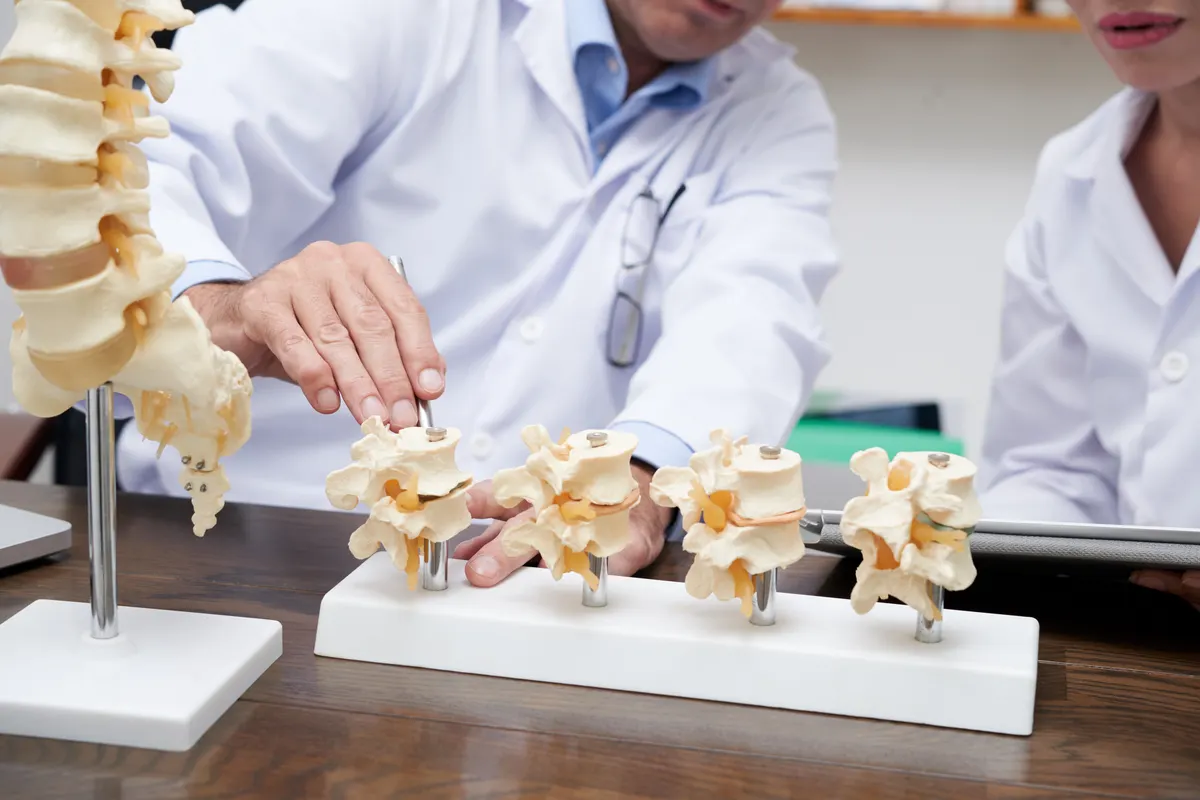
How discs get injured
Most herniated discs develop from slow wear. With age, discs dry out, stiffen up and can split during a slight motion like bending or twisting.
A fall or a hard impact causes it less frequently.
What a disc injury can feel like
What patients often describe
- Neck or back pain that appears and then fades
- A sharp, jolting ache that travels down an arm or leg
- Numbness or tingling in a hand or foot
- Weakness in an arm, hand, leg or foot
Common causes
- Lifting with the back, not the legs
- Pulling, pushing and bending on the job
- Hours of driving with engine vibration
- A collision blow, or a fall
Checking a disc problem at your first visit
Where it travels
Dr. Sim asks where the pain began and whether it travels into an arm or leg, then presses along the spine to find tender areas.
A nerve check
He checks your reflexes, muscle strength, walking and sense of touch. When the exam points to it, we take an X-ray here to view the bones near the disc.
Care planned around the findings
Soft-tissue work and adjustments are matched to the nerve picture. Every visit's notes accompany your claim.
Who treats you, and who pays

Dr. John Sim sees every patient at this clinic. He and the reception staff speak English, Spanish and Korean.
Heavy work raises disc risk. If yours came from the job, we're a registered Washington L&I provider, and covered care under an accepted claim has no out-of-pocket cost. If a crash is the cause, Personal Injury Protection (PIP) can pay for reasonable and necessary care regardless of fault. We bill eligible PIP claims directly.
Related conditions
Questions about disc injuries
Can a car accident cause a herniated disc?
A crash is a less common cause. Mayo Clinic states most herniated discs result from gradual wear, and only rarely from a fall or blow to the back. AAOS notes a disc can also rupture suddenly after trauma. If your symptoms started with a crash, the exam documents them for PIP.
Will an X-ray show a herniated disc?
No. An X-ray displays bone, so it cannot reveal the disc itself. It can help rule out other problems, like a fracture. Mayo Clinic says a history and physical exam are frequently enough to pinpoint a herniated disc.
Does a herniated disc need surgery?
Most people do not. AAOS reports only a small portion of those with a lumbar disc herniation require surgery. It is considered when other care has not helped, or if there is muscle weakness, trouble walking, or loss of bladder or bowel control. Those last signs call for urgent care.
Call 425-743-9460 to schedule an exam with Dr. Sim. Reception can tell you what to bring for your claim.